
hot take: you already have creative instincts, you’re just not paying attention
2 everyday places your ‘creative genius’ has been hiding (with prompts + rituals)

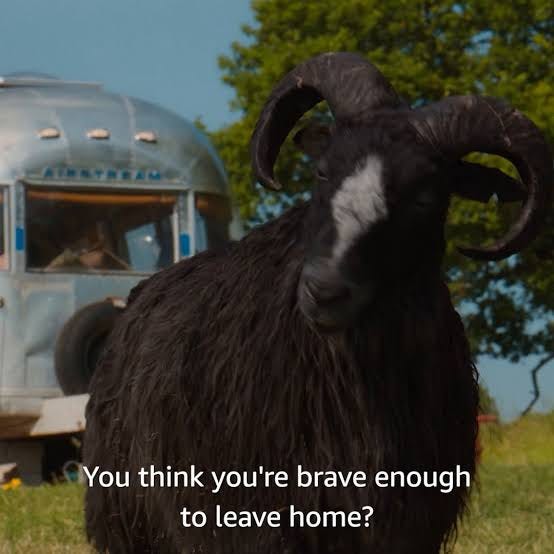
The other day I was watching “The Sheep Detectives” (available on Prime), and two things caught me off guard:
I didn’t expect to get emotional over some CGI talking sheep solving a murder mystery (yep, you read that right);
and the intelligent, precise mirror it holds up on how much of the population today moves in a “sheep mentality” - gullible, mindless, follower animals who conform to society's expectations; assuming they are incapable of deep thought or agency.
That is until the “black sheep” shows up with its outsider perspective, challenging their blissful ignorance to tell that true wisdom comes from embracing differences and facing reality. It’s this black sheep that proves that the animals (and people) everyone wrote off as ‘stupid’ or ‘docile’ are actually capable of critical thinking, bravery, and seeing what everyone else decided not to look at.
And that’s where it hit me with the “omg” moment.
In many ways today, the algorithm-curated, engagement-optimized content loop we live inside - the overconsumption, brainrot, and AI slop - is doing this to us. Platforms are increasingly deciding what we consume, creating a continuous feedback loop that conforms us to have uniform taste, language, and the more critical - even behaviors and beliefs.
We’re exactly trudging towards a path of being the herd-minded sheep, prioritizing comfort over confronting the truth and questioning these so-called ‘systems’.
And the actual, deeply personal antidote is in finding our own lens - based on our lived experiences and even the simplest day-to-day stories. The way you make sense of your life and self become key in balancing the scales to this “flattening” we’re witnessing today - one that keeps us in boxed echo chambers that lack soul, prevent curiosity, and promote us to keep returning to a "safe," familiar bubble of thinking.
I recently talked about how long it took me to understand the importance of bringing our sense of self into the work we do and the life decisions we take - and how it’s our most valuable asset today in a world that keeps itself limited to sameness.
Extending on the same, I’m now on the research journey to unravel exactly where to begin locating this “sense of self” - the specific places your creative genius has been hiding - and in that, also help you build the blocks towards a signature language that gets you recognized for being unmistakably, irreplaceably yours.
And what would you know - it’s been in places you’re already much familiar with.

the ‘ceiling’ that comes in many flavors
Let’s get one thing straight: finding your sense of self has to begin on the path of complete, unglamorous, uncomfortable truth.
And it begins with asking the one question we usually tend to avoid or play down:
where exactly am I putting ceilings on myself that is keeping me from reaching what I actually crave to do, and why do these ceilings feel so reasonable?
You see, much like sheep, humans have the tendency to seek belongingness. Which isn’t wrong, by the way, it’s just how our brains are wired because our survival is its utmost duty. Our amygdala has evolved to produce false alarms when it faces anything new and unfamiliar in order to keep us ‘alive’, and so it tends to keep defaulting to the familiar.
Of course, our evolution has taught us that being in flocks/groups/communities = familiarity = safety = survival.
Over time, this “herd” determines how we think, act, what beliefs and values we uphold, and shape the very narrative of our world. But what we don’t often realize is that this familiarity keeps building a false sense of a singular, shared reality - one so solid that questioning it starts to feel like a personal attack on everyone around you.
And this is how most of us end up capping ourselves; not because we lack ability but because we've internalized other people's definitions of "good enough."
Gay Hendricks in his book “The Big Leap” calls this the “Upper Limit Problem” - a psychological glass ceiling that keeps us from reaching our ultimate potential because we subconsciously self-sabotage our progress every time we get close to it, retreating to the safe, familiar manageable version of ourselves.
And this is why identifying your specific Upper Limit/ceiling is a strategic mandate to reach your creative genius. Why specific? I’m a big believer of subjectivity, so of course, no one’s “ceiling” will look the same.
For instance, if I told you right now that you could earn a million a month starting from an entry-level role, you’d probably call me delusional. On the contrary, you’d find it much easier to believe that you’d get somewhere on average between a 30-40K per month at best. So you aim there. You stay there. You build your entire life around proving that number right. And it’s not because it's what you actually want, but because it's what your subconscious has decided is the outer limit of what “someone like you” gets to have.
What we don’t realize is that this “inability” to take action for something we truly ache to do and believe in has much less to do with our capability, and more so to do with the subconscious wall we’ve built because of the fear, failures, or ‘well-meaning’ warnings people have fed us that got absorbed within us as facts.
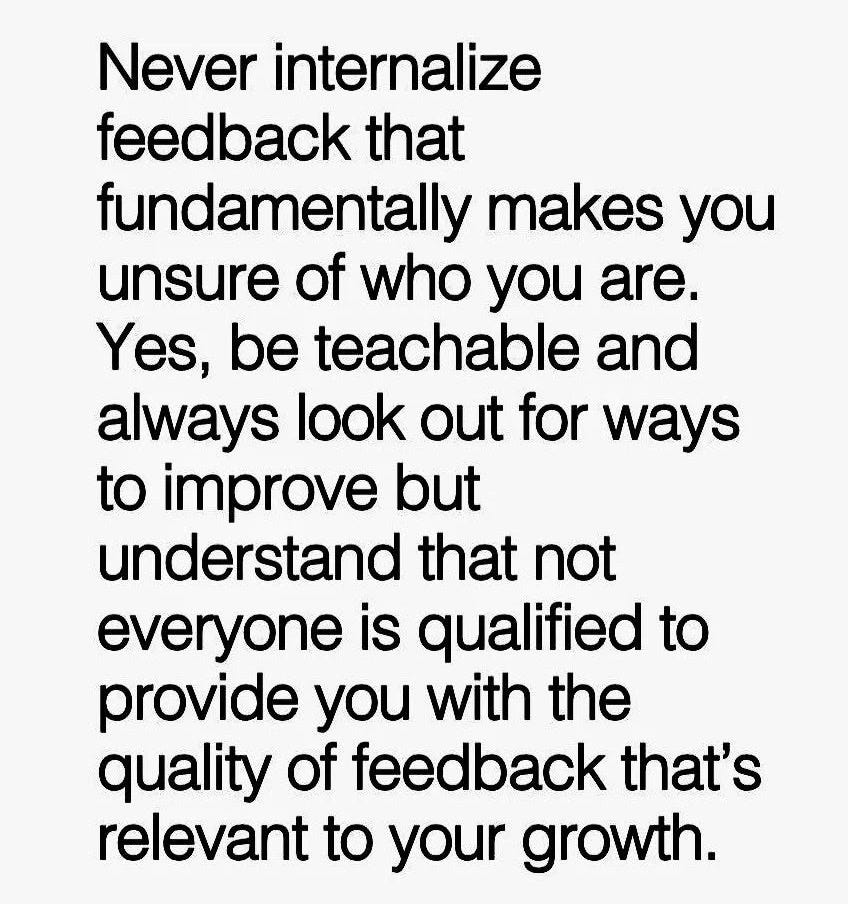
I’ve personally stopped associating with phrases like “things take time”, “money doesn’t come easy”, “success means sacrifice” - they’re limiting beliefs to me, while to some they may be stepping stones to resilience. Your ceiling might look completely different, and that’s exactly the point.
*Again, with any form of self-concept work, bias is inevitable (pretty sure mine would also be apparent here in some shape or form). Which is why nothing I say here should be taken as prescription. It's an invitation to locate your own subconscious blocks - those formed by the most intense emotional experiences/observations of your lived life.
Bring up those traumatic experiences that you’ve, over time, accepted as evidence of your limitations.
For a good enough price, I’ll keep having feelings in public ;)
the “flow state” vs. what creativity actually demands
You know how we often say “don’t disturb me, you’re going to ruin my flow” while doing something we’re utterly engrossed in? Yeah… this is where those muddled threads inside your mind start to neatly fall in place.
If you’ve watched F1: The Movie, Sonny (Brad Pitt) makes a similar confession: “I don’t drive. I fly. Just for a minute. It’s all gone. The sound. The fear. Everything. That’s the moment I’m chasing.”
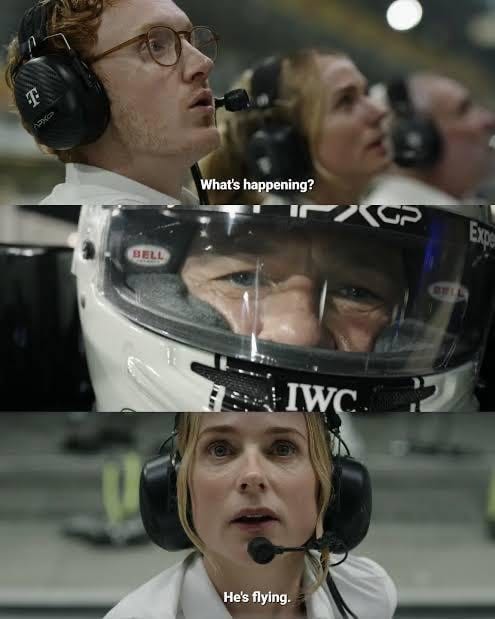
This “flow state” - according to Mihaly Csikszentmihalyi‘s 70s theory - is a psychological state of optimal human engagement. It’s a moment of total immersion where a person’s skills perfectly match the challenge of an activity, leading to heightened focus, intrinsic motivation, and deep fulfillment.
Hendricks maps this via the 4 Zones of Human Activity, where the “Zone of Genius” is the “Einstein Time” - a mental state and operational space where your natural, innate gifts intersect with your passions. It is the work you are uniquely suited to do, often causing time and space to disappear when you engage in it. And if you’re familiar with the Japanese concept of “Ikigai” (a reason for being) - yep, similar story.
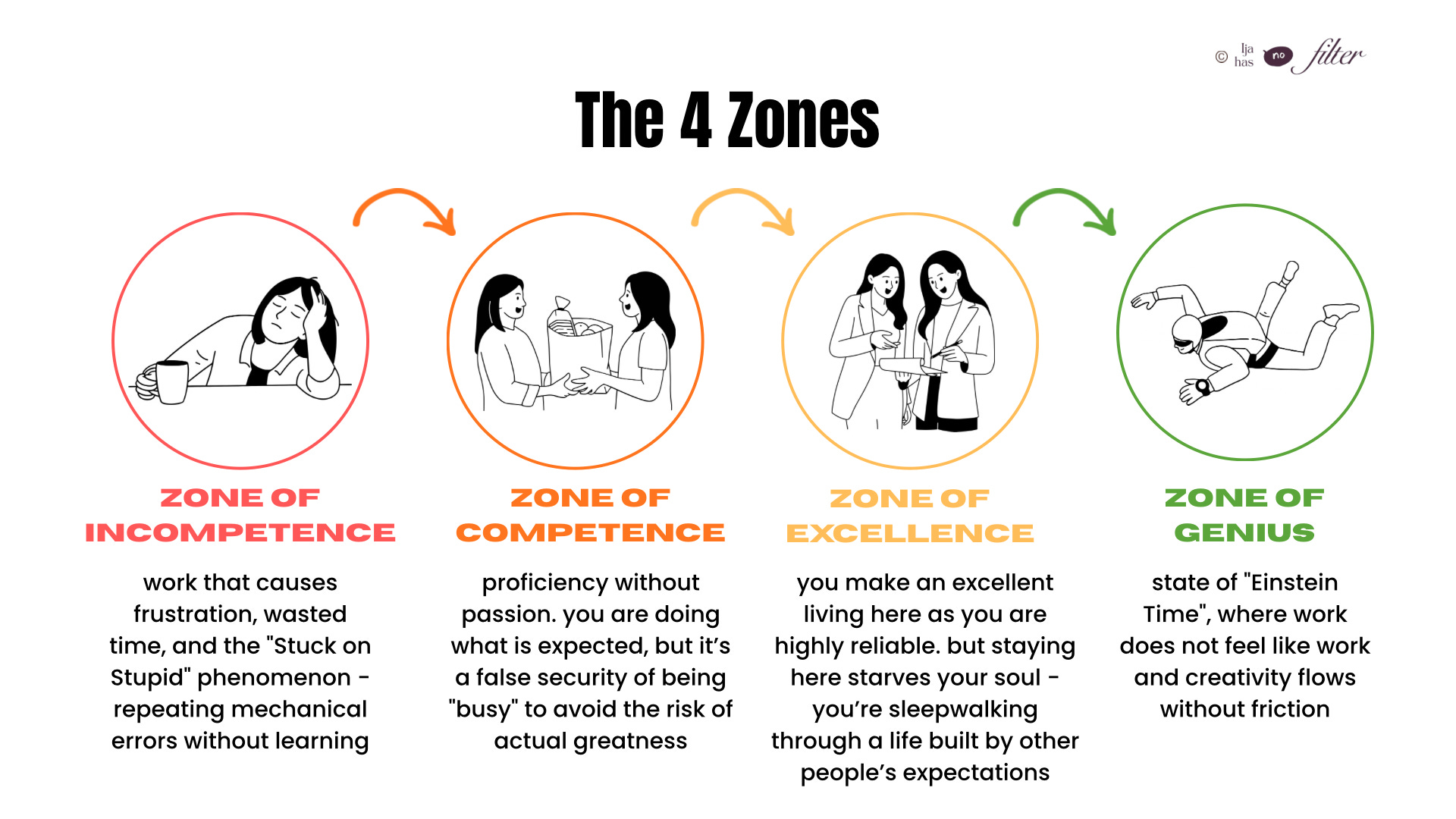
Most of us tend to confuse our “Zone of Excellence” with our “Zone of Genius”. I don’t blame you, having lived there and done that with my career choices the past 5 years. After all, Excellence is that zone of “comfortable numbness” - it gets you praised, and it makes you convenient (read: predictable) to the people around you - your family, peers, organization, the society - in ways that fulfills their needs beautifully. The issue with this is that it's a ceiling that feels like a ceiling you chose, when really it was chosen for you by everyone who needed you to stay manageable.
The black sheep, the ones who take the leap, in turn are just the ones who let their sense of self make the decisions instead of the comfort of being needed. Many of them spend time in Excellence too, using it as a stepping stone, building skill and stability while tracking what actually lights them up underneath all of it.
When it comes to creativity, we need to have a quick reality check with the flow space:
creativity is not a field, or a personality type. It's not something you either have or you don't. It's a skill: practiced, trained, and developed the same way any other skill is.
And like any skill, it starts before you're good at it. It starts in the noticing, in the collecting, in the small daily act of paying attention to what actually calls your name than what should call your name - not what would ‘look good’ calling your name, but what really, soul-satisfyingly does.
Which is exactly where we start with locating our creative genius in the 2 places we’ve lived and known:
1. revisit your childhood for creative liberty and bravery
There's a reason therapists, psychologists, and that one person in your life who's done a lot of inner work keep circling back to childhood. And no, it's not just trauma excavation (although, yes, sometimes that too). It's because childhood is where our unfiltered, non self-judged, nobody-told-me-what-to-want-yet self lived - one who picked things up not because they were glittering with practicality or impressiveness, but because something in it just had to.
Proust (1913) described childhood memories as the raw materials of identity - the sensory, emotional bedrock that everything else gets built on top of. After all, your childhood shows up in the wounds in your relationships, in the self-worth you carry into careers, and the overall self-image you hold up for yourself throughout life.
The “childlike wonder” that we keep looking for in our adulthood is exactly where the essential ingredients to the fulfillment we keep desiring live. Your curiosity here lived before it learned to be embarrassed, your passion existed here before someone told you it wasn't a career path, and here’s also where your ‘unimagined’ - the ideas, the interests, the combinations nobody else thought to make - first started taking shape.
Now, one’s childhood can carry all kinds of tastes. Maybe yours was warm, gooey like a freshly-baked cookie that has the right balance of crunch and softness - supported, full of resources and people who cheered you on; in which case, your nostalgia probably points toward joy, whimsy, and the things that made you feel genuinely alive. Or maybe it was harder than that, like the messier, wrong-proportioned batter, and creativity was more of an escape hatch where you built new worlds for yourself out of necessity. Either way, your childhood holds the answers to what you were drawn and inclined to do before the world told you what was practical, where you already had your own instinctual preferences.
In order to tap into that energy again, we’re going to answer a few questions with utmost honesty (not performed, palatable version of honesty), and then take action to reconnect with those activities:
📝 prompts to sit with:
What did you do for hours without anyone asking you to, before you knew “hobbies” was a category? (for me, it was personality quizzes, astrology deep-dives, watching lifestyle shows about human-interest stories on TLC. That’s how I knew I loved finding myself while equally knowing diverse perspectives, and hence I chose Psychology as my major).
What are the activities that you’d still do in a heartbeat today that adults called a ‘phase’ or ‘time pass’? (was it gaming? modeling? painting nails? browsing magazines? Don’t underestimate it, think vague and random - we have people selling feet pic courses or becoming millionaires from gaming).
What did you teach yourself without instruction - not what you were told to study but couldn’t help exploring? (for me, I would go out of my way to discover new online games for hours, mostly spending time playing in virtual worlds. This is how I know I love community-building and interacting with like-minded people).
💡 try this:
Pick just one activity/interest from your answers and give it a weekend - no future planning, no monetization strategy. Just a weekend where you let yourself be bad at something you used to love, or try something you've been aching to do for years. Thirty days of showing up to it, even badly, will tell you more about whether it belongs in your ecosystem than any amount of thinking about it will.
2. that one thing you’d not even let a deadline touch
You know that “alright, just a 5 mins” lie you tell yourself even when the mounting pressure of a deadline is at stake? The one where you're going to quickly check your horoscope, or send one voice note to a friend, or scroll through three reels… and then somehow 40 minutes have evaporated and you feel more alive than you did doing the actual work?
I'm not calling you out. I'm here to tell you that's the most honest data point you have about yourself.
Knowing your sense of self, and thereby your creative genius, is a daily diagnostic. Most of us move through our days consuming enormous amounts of information, completing task after task, and never once stopping to notice what's naturally capturing our attention vs. what we're just getting through. The reels you don’t swipe past, the article you’re willing to read despite the 15 mins read time, the show/book that you’d binge watch/read till 3 AM even though you have to wake up at 7 AM. These “distractions” are actually signals for what is building your energy, sparking new neural connections, all the while cross-training your brain in directions you otherwise are never asked to go to.
📝 prompts to sit with:
On your most overwhelming workday, what do you find yourself doing for "just 5 minutes" that always runs longer? (yes, it could be as simple as surfing through different social media platforms. But take the time to notice. Which posts do you stop on? Which tweets do you screenshot? Which reel do you add to your save later? The empty-fridge scrolling is universal. What you keep returning to inside it is personal).
What do you consume purely for pleasure that has nothing to do with your job, and what specifically about it pulls you in? (I spent 4 years in fintech research, but was always pulled toward the latest fashion week coverage, new runway collections, or who-wore-what to the Oscars or the Met Gala. Now I know I’d like to build a style guide as one of my publications here).
What topic makes you talk faster, louder, or longer than you intended? (you know, the ones that hijack dinner conversations, that has you suddenly standing slightly straighter, eyes going a little sparkly, talking with your hands. The one that has people looking at you in awe because you became more you. Yep yep, those ones).
💡 try this:
For one week, keep a running note (voice memo, notes app, napkin, whatever) of every "just 5 minutes" detour you take. No judgements, justifications, this-won’t-works. At the end of the week, read it back like it belongs to a stranger. What does this person clearly love? What keeps showing up? What would you tell them to pursue if they came to you for advice? Then take your own advice, considering that stranger is just you who hasn't been giving yourself the permission yet.
we’re only getting started
Finding your creative genius isn't a one-afternoon revelation - it won't arrive neatly after you answer a few prompts and take a weekend trip down memory lane, and anyone who tells you otherwise is selling something.
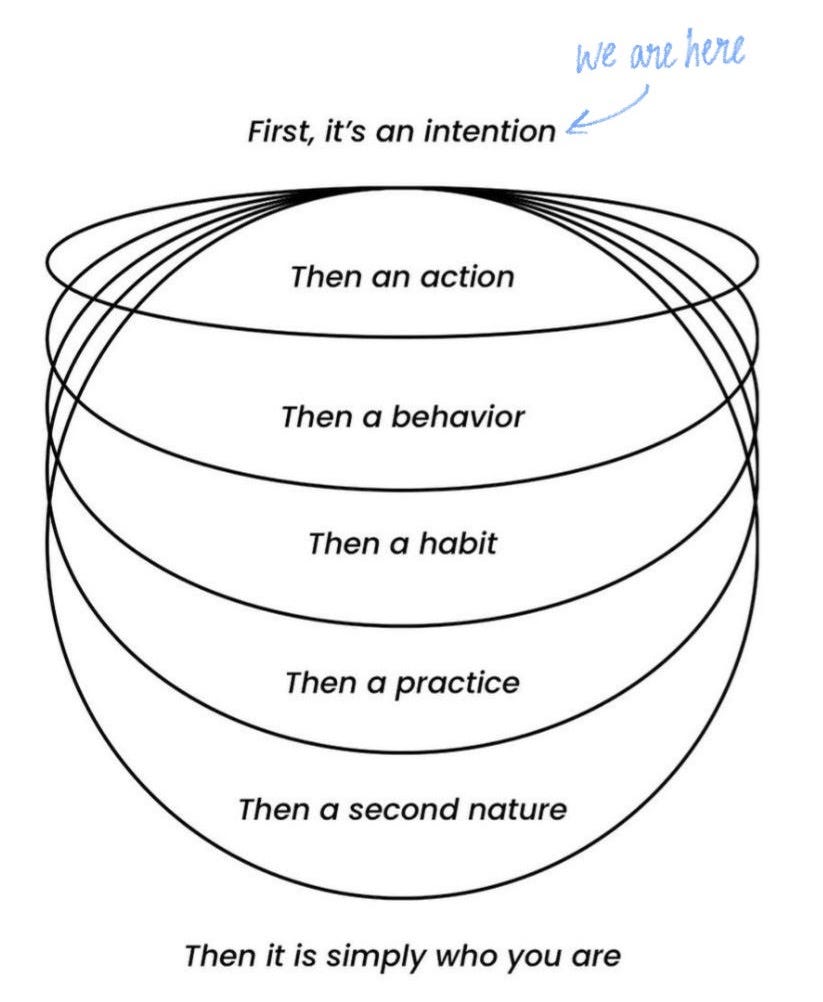
What we’ve just gone through was the initiation step. You start looking. And that matters more than it sounds, because most people never even actually look (let alone notice) - they wait to feel ready, or inspired, or certain, and spend years outsourcing that search to job titles and other people's timelines instead.
But locating what lights you up is only half the equation. The other half - the part that actually turns these scattered interests, childhood memories, and “just 5 minutes” detours into something coherent and yours - is building a system around them. A personal research practice: your way of collecting, connecting, and eventually creating from everything your sense of self is already drawn to.
In the next pieces, we're getting into:
the research practice: how to turn everything you consume into a living, breathing creative archive that feeds your work instead of just sitting in an unsorted folder somewhere.
and from there, we'll get into something I'm particularly excited about: why thinking in ecosystems instead of niches is the move that makes all of your seemingly unrelated interests finally make sense together.


This has to be my favorite article you'ev ever written.
I really loved The Sheep Dectectives reference at the beginning, but what stood out to me was the F1 reference with Sonny Hayes's Dialogue, "I don't drive. I fly 🕊️. That dialogue was another moment that really stayed with me. Both references felt incredible.
There were a few moments that made me pause, especially:
"Our evolution has taught us that being in flocks/groups/communities = familiarity = safety = survival."
that line stayed with me
I even have to admit that I was initially confused by the part where you mentioned you've stopped associating with phrases like "things take time", "money doesnt come easy," and "success means sacrifice.", At first I wasn't sure where you were going with it, but later, after reading it, I realized the point wasn't about rejecting those, but it was more about how our cellings are deeply personal. It clicked only after reading 😂.
I really appreciate the prompts you have provided. They were really thoughtful and helpful, where i fell people will stop and reflect as well. The way you blended psycology, personal experiences, flim references, and practical prompts made the whole article feel immersive.
Looking forward to reading more from you.
Ija, this one hit close. ❣️
My honest "just 5 minutes" is falling into research about some obscure atelier or embroidery technique I have no immediate reason to be looking into, and I used to feel almost guilty about it, like I was avoiding real work. Reading this made me realise that rabbit hole basically became my whole career eventually, I just didn't trust it while it was happening.
The bit about excellence being praised while genius quietly gets ignored is the part I keep thinking about. Excellence gets you told you're doing great. Genius just gets you time disappearing and nobody clapping for it yet. I think that's why so many people, myself included at points, stay in the version of themselves that's easier for everyone else to understand.
Proud of you for writing this one, truly. So beautifully written 🩷